Posted on

Noir in the Naked City – Episode Three: Hate

Naked City Atlanta logoNaked City is a monthly live literary event held at the Goat Farm in Atlanta. Each month, the hosts reveal the theme for the next month and people sign up for the privelege of getting five minutes to speak, sing, or do whatever on the subject of the theme. Go over your five minutes? Then you must spin the Wheel of Consequences!

Naked City’s website
Naked City’s Facebook page

Starting in February, I began a writing challenge for myself: A crowd-influenced serial called Noir in the Naked City where, at the end of each episode, the protagonist would be faced with a choice. The audience would make the decision for the character, and then the next episode would be written with that choice in mind AND on the next month’s theme.

We’re four episodes in now, and new audiences are probably going to be a bit lost. So I’m posting them here so people can catch up. I’ll post one per week until we’re caught up, and then the next episode will go live right after the event itself. Hope you enjoy them!


Episode Three: Hate

Sometimes you just never know where you’re going to end up. Sometimes choices can be a real bitch. And sometimes you make the wrong one. Currently I was faced with a choice where both options were suboptimal in the extreme. On the one hand I could head down to the train yard, following a free lead from a known selfish prick who never gave away anything for free. On the other hand I could follow the mug in the doorway who was frantically motioning for me to come over there. The flames from the recent explosion down at the train yard were billowing up into the air like Marilyn Monroe’s dress over the grate, except a lot less attractive. I could already see the guards scurrying around like heavily armed ants over a mound that had recently met the business end of a sturdy boot. And I could see the mug in the doorway being impatient, his long trench coat and hat obscuring most of his features.

I glanced at my watch. It was a heavy pocket watch, engraved with some poor schmoe’s retirement message. I’d picked it up from a pawn shop. I guess retirement hadn’t gone all that well for this guy. The watch face read 11:59pm, one minute until I was supposed to meet this supposed informant that Gek had sent me to meet. Or had he? All he’d said was that I had a train to catch. Maybe he meant for me to go up in flames, roasted like a cheap scallop dredged from the ocean floor so it could become dinner for a species that only considered itself dominant because it acted like it hadn’t heard of insects.

I glared at the shadow in the doorway. Its motions were becoming more insistent, more frantic. Clearly he wanted to be out of there before the guards started their inevitable canvass of the surrounding area. I inwardly rolled my eyes and began the laborious process of getting up off the street and flinging myself into the doorway to see what the mug wanted. Once he saw me moving in his direction, he darted off and ducked through a doorway. I followed, knowing in my gut that I would regret it.

On the other side of the door was an extremely large room that was mostly empty except for a man sitting in a plain wooden chair with something furry on his lap. The mug was shedding her trench coat and hat to reveal a woman in a brilliant red dress so tight it looked like someone had bled on her. She had hair as black as der fuhrur’s soul, eyes as green as the envy in a man’s heart, and legs that went on and on and on…like a PBS pledge drive. A dame. This was about to get a lot more complicated.

The man looked up at me, his rheumy eyes clearly bloodshot even from across the room. The bundle of fur in his lap opened its eyes and stretched a long orange tabby paw, its claws raking the air. And that’s when it got a LOT more complicated.

“Good evening, detective,” the woman said. She had only the slightest trace of a German accent in that soft, lilting voice of hers. I made no reply.

“You’re probably wondering why you’re here,” she continued.

“Yeah,” I said, my eyes not leaving the cat on the old man’s lap. I wasn’t afraid. What I was was curious.

“I will come straight to business,” the woman said. “We want you.”

“Get in line,” I replied.

“You jest, but you have something my employer needs desperately.” She took a cigarette from a small table nearby and lit it, the smoke encircling her head like a halo. I couldn’t help but think that that was an accessory she would never be able to wear effectively.

“That him there?” I asked, indicating the old man.

“Of course,” she said.

“Tell him to get rid of the cat and we can talk about it.”

The woman looked puzzled for a moment, and then burst into laughter. “Detective, the cat is my employer. The man with him is just for warmth and companionship.”

“I hate those things,” I said, deciding not to mince words.

“The fact that you are not surprised tells me that you are exactly the person we need,” she purred.

“What do you need me for?” I asked, knowing I would hate the answer.

“My employer and I are of a similar mindset. We feel that, given certain technological advances recently, that humanity is on the verge of a new age. But it will be an age of bigotry and hatred, repression and segregation. We think we are so enlightened because we have integrated all races, religions, and creeds into a universal tolerance where everyone gets along. But people are inherently distrustful and are always looking for the next group to oppress to make themselves feel superior.”

“What’s this got to do with me?”

“You know perfectly well,” she snapped. “You are only the first member of the next group to be shunned and feared. You already experience it daily.”

“And what do you and your…employer intend to do about it?”

The cat yawned. The dame continued talking “We intend to follow in the footsteps of one who knew all about hatred and oppression, but got the details wrong. There isn’t a master race…but there could be. And we will create it together, the three of us. What do you say, detective? Will you join us in creating the next step in the evolutionary cycle and prevent another hundred years of violence and hatred in the process?”

I thought it over. She had a point. It was tempting. If I joined them I could forget about the poor jerk murdered in his car. Clearing my name wouldn’t matter anymore because in this scenario I’d be in charge. But could they do it? Could I do it? I had to decide – continue with the case and worry about these two stabbing me in the back, or join with them and worry about what would happen if they failed…or if they succeeded.

CHOICE: Continue with the case? Help the dame and her feline employer create a new master race?
 

Posted on

30 Years of ARTC – Throne of Shadows, Dragon Con 1999

This being our 30th anniversary, we thought we’d dip back into the past and recap some of our previous performances, triumphs and tragedies, in a series of posts. And don’t forget our Chronology! It’s not as detailed, but it really shows the growth of ARTC over the years. You can see all of the photos in their full size on our Flickr album!

ARTC has been priveleged to perform at every single Dragon Con since the very beginning back in 1987. In 1999 we debuted the audio version of Thomas E. Fuller’s Throne of Shadows: The Last Relic of the Empire. It’s a complex story involving the Emperor of Mexico, an actress pushed to her limits of sanity, and an alternate history of the way things really went in 1867. But leaving geopolitics aside for a moment, the story is really about the love that Maximilian shared with his wife Carlota and how that love transcended death and madness.

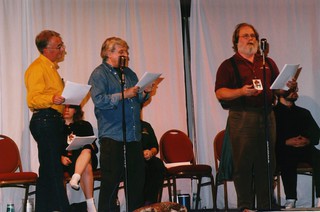
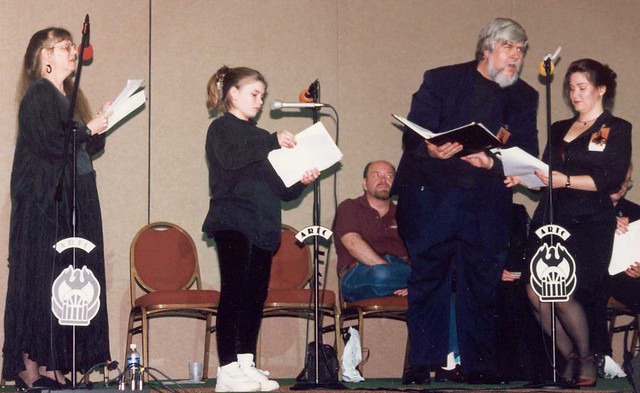
The cast of
The cast of “Throne of Shadows”

In this photo we see an extremely young Sarah Taylor as the fictional Sofia, along with several other members of the cast of the production. We managed to get Sarah into the studio to record her lines while she still sounded like a girl instead of the young woman she has grown up to be. Also pictured, Trudy Leonard as Carlota, Dena Friedman Williams as the actress Victoria Forell, and Thomas E. Fuller as Emperor Maximilian.

Foley for
Foley for “Throne of Shadows”

Foley for Throne of Shadows was fairly involved. There was lots of walking around on castle floors when the scenes were set in Bavaria, but when the scenes magically shifted to the Mexican Empire in 1867, it was occasionally necessary to have dense foliage available. One side set in winter, the other in a glorious Mexican spring.

Brad Weage at the keyboard

Brad Weage composed the haunting score, including the essential “Imperial Waltz”. For the final studio production, Joel Abbott provided a good deal of a replacement score, due to Brad’s original compositions being unavailable, but the “Imperial Waltz” lives on!

Posted on

Noir in the Naked City – Episode Two: Progress

Naked City Atlanta logoNaked City is a monthly live literary event held at the Goat Farm in Atlanta. Each month, the hosts reveal the theme for the next month and people sign up for the privelege of getting five minutes to speak, sing, or do whatever on the subject of the theme. Go over your five minutes? Then you must spin the Wheel of Consequences!

Naked City’s website
Naked City’s Facebook page

Starting in February, I began a writing challenge for myself: A crowd-influenced serial called Noir in the Naked City where, at the end of each episode, the protagonist would be faced with a choice. The audience would make the decision for the character, and then the next episode would be written with that choice in mind AND on the next month’s theme.

We’re four episodes in now, and new audiences are probably going to be a bit lost. So I’m posting them here so people can catch up. I’ll post one per week until we’re caught up, and then the next episode will go live right after the event itself. Hope you enjoy them!


Episode Two: Progress

Choices. Life’s full of ‘em. You make one, it leads to another, which leads to another, an endless string of consequences flowing through everyone’s life like a river downstream from a major city. The question is whether the river is filled with honey…or blood. Currently my choices had me shambling down the street through a rainstorm that would give a respectable monsoon a run for its money without my hat.

I’d been going like this for about an hour. I don’t drive a car, don’t trust ‘em, and I can’t work the pedals in any case because of my special circumstances. My special circumstances also mean that I fall down a lot, but it’s ok. I’m used to it. I turned a corner and made it as far as a local movie theatre before falling down, which I considered the moral equivalent of winning a biathalon and the Boston Marathon on the same day.

The marquee threw its harsh neon message at me like a shotput, burning my eyes out with its brilliant intensity, announcing to the world that something part fifty was having its 30th anniversary.  I briefly wondered if the last original idea that left Hollywood had turned off the iron before it went out, but then I decided I could ponder the artistic integrity of the average moviegoer better from the comfort of my own apartment. I wouldn’t be making it there tonight, I suspected, but the thought gave me the motivation I needed to get going again. I staggered up, shifted my weight, did a forward roll, used the momentum to get my feet under me, and moved on.

I was nervous. Gek had told me that I should be at the train yard at midnight. There were all kinds of things wrong with this. First, the trains didn’t run that late. Second, he told me this at just after 10:00pm and he knew it would be a push for me to make it there in time from his place. And third, while it’s true that he knows a ton about what goes on in this burg, Gek doesn’t give away information for free. This was going to cost me and it was only a matter of time before the bill came due.

I nearly didn’t go at all. But I didn’t have a lot of other options available. At this time of night all my usual informants were going to be asleep, in jail, or otherwise occupied with each other. Not to mention hard to find. At least the train yard didn’t move around.

After another forty five minutes of staggering, stumbling, falling, and getting back up, the yard finally came into view. I stopped to catch my breath. Normally this kind of trip wouldn’t take that much out of me. I’m pretty tough, but the sustained breakneck pace had put an ache in my body that made me think my muscles were staging a revolt. Plus, I couldn’t get warm with the rain pelting down. I gotta move to Venice some day so I can just swim everywhere I need to go. A part of me wished I had my leg braces with me, but I rejected the idea. I needed the flexibility when I was on the job.

The train yard, visible now at the bottom of a hill about two hundred yards away from me, was a glittering vista of shiny metal and polished plastic. There’s a kind of romance about trains and locomotives that’s ingrained into the collective unconcious, and this place had about as much of it as a single man’s apartment the day after Valentine’s Day.

People think about trains and they think of  locomotives hauling lumber, coal, and hobos across the great expanse of the American midwest, connecting the great cities and bringing goods and culture to the masses through steam, grease, and a plaintive whistle that echoes forlornly through mountain passes. There’s an element of danger, where desperate men gather to seek out new lives and fortunes and risk death by misadventure for the thrill of exploration and dreamed-of riches.

That’s just because they haven’t ridden one lately and get all their news from picture books. These trains were maglev bullet trains designed to hurtle along tracks at nearly 200 miles per hour. They shone when the sunlight hit them and glittered in the moonlight. There were no desperate men here, unless they were desperate to get away from the guards that patrolled the area like ants invading the picnic of life. Trains had been big business once and were becoming so again thanks to modern technology and people’s insatiable need to be somewhere besides where they were.

I glanced at my watch. 11:55pm. I gathered myself for one last plunge down the hill, fully expecting to have to roll most of the way there, when suddenly there was a massive explosion at the far end of the yard. A plume of orange fire and thick, dark smoke billowed up into the night sky, casting garish shadows on everything in the general viscinity. I hit the dirt and swore, a long and lurid string of expletives that rivaled the explosion for heat and intensity. This was a mixed blessing. On the one hand, it meant that all the guards were going to head for the explosion – a better distraction would be hard to find. On the other hand it meant that everyone was going to be on high alert. Besides, what fool runs TOWARDS an explosion when he’s already a suspect for murder?

“Psst”

It was barely audible over the sounds of the fire raging and the alarms that had started down at the train yard, but still distinct.

“Psst”

About twenty feet away I could see a shadow detaching itself from a brick wall, motioning for me to come over. I looked at my watch again. 11:58pm. If I hurried I could still get to the train yard before midnight. Could the person I was supposed to meet have set the explosion as a distraction? If so, they weren’t going to linger. I could rush to the yard and try to find them in time or I could see what the mug in the doorway wanted. But I couldn’t do both.

CHOICE: Continue to the train yard? Follow the mug in the doorway?

Posted on

30 Years of ARTC – Decatur Arts Festival 1999

This being our 30th anniversary, we thought we’d dip back into the past and recap some of our previous performances, triumphs and tragedies, in a series of posts. And don’t forget our Chronology! It’s not as detailed, but it really shows the growth of ARTC over the years.

ARTC has performed at the Decatur Arts Festival on five separate occasions. We loved our experiences there, but the fact of the matter is that outdoor venues aren’t kind to us from an acoustic point of view, and often from a weather point of view. Our 2004 Frontier Days performance was particularly memorable. Ask us about it sometime! You can see all of the photos in their full size on our Flickr album!

But, that said, we did get appreciative audiences. Here’s a few of our favorite moments from the show!

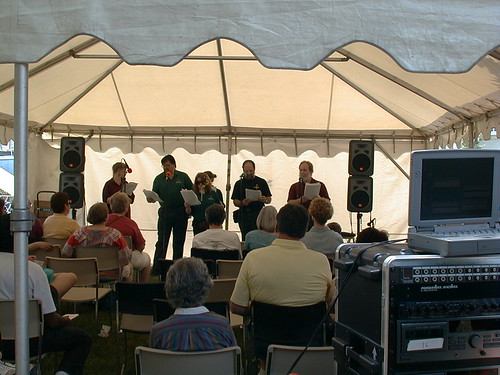
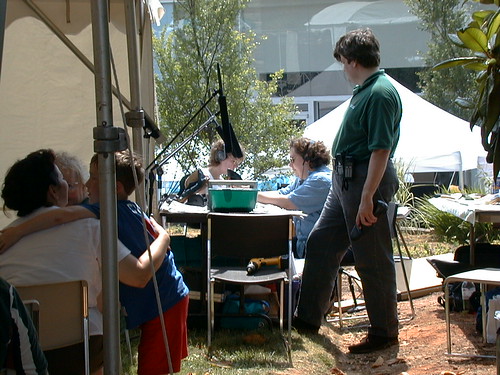
Trudy Leonard, Clair W. Kiernan, Tony Trauring, and Daniel Taylor perform.

As you can see, we’re in a tent. It was a lovely sunny day and the tent helped keep the sun off our heads. Rain would have been a completely different story.

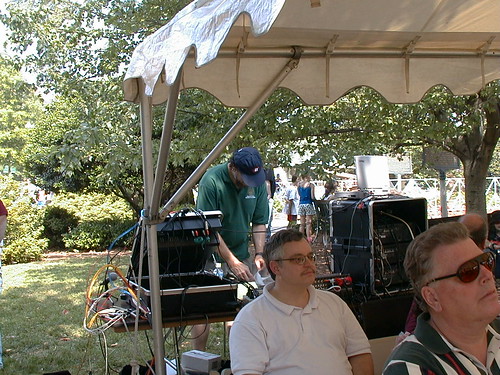
Bill Ritch and Thomas Fuller look over the technical side of things.

One of the great things about this festival was our opportunity to connect with some of our younger fans (and fans-to-be!).

Old tech helped make this show possible.
Check out the ancient technology!

Trudy Leonard, Daniel W. Kiernan, Clair W. Kiernan, Tony Trauring, and Daniel Taylor are on the stage playing to a decent audience, but what’s really interesting here is the tech in the foreground. Check that stuff out. An actual tape deck! And that laptop had to weigh ten pounds. Not pictured: A ton of other stuff we don’t have to use anymore thanks to modern technology. Now we lug around completely different (but equally heavy) stuff!

More older technology in use for the show
More ancient tech

Some of it is pictured here. But that’s still not all of it.

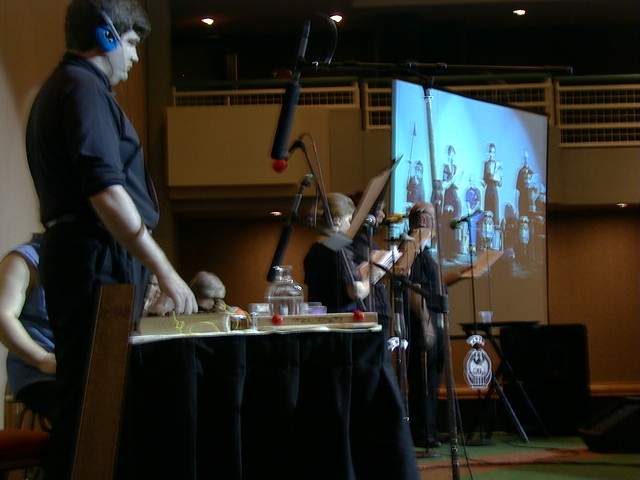
Foley table for the show
Foley work

Foley stays pretty much the same. I think we used some of those props at our last performance!

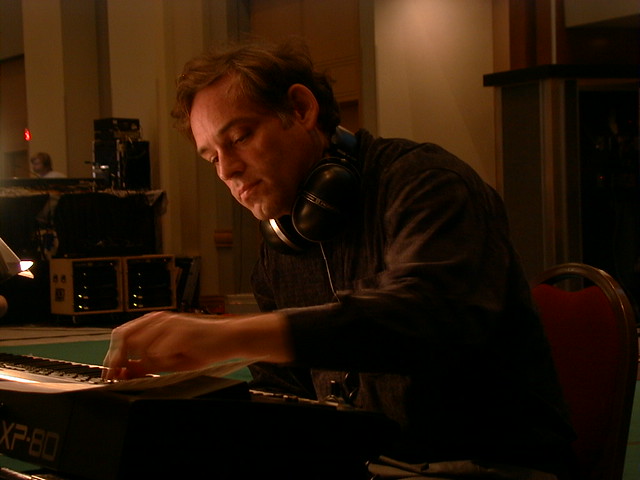
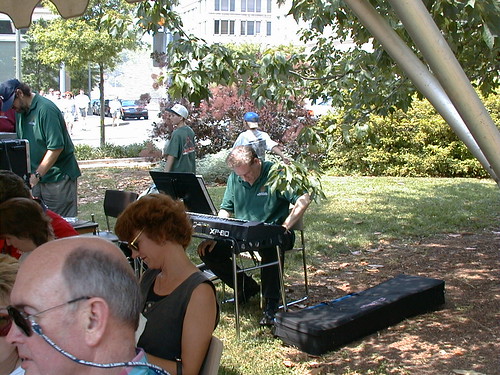
Brad Weage at the keyboard

And what trip down memory lane would be complete without Brad Weage? Here he is right at home behind his keyboard.

Posted on

Noir in the Naked City – Episode One: Obsession

Naked City Atlanta logoNaked City is a monthly live literary event held at the Goat Farm in Atlanta. Each month, the hosts reveal the theme for the next month and people sign up for the privelege of getting five minutes to speak, sing, or do whatever on the subject of the theme. Go over your five minutes? Then you must spin the Wheel of Consequences!

Naked City’s website
Naked City’s Facebook page

Starting in February, I began a writing challenge for myself: A crowd-influenced serial called Noir in the Naked City where, at the end of each episode, the protagonist would be faced with a choice. The audience would make the decision for the character, and then the next episode would be written with that choice in mind AND on the next month’s theme.

We’re four episodes in now, and new audiences are probably going to be a bit lost. So I’m posting them here so people can catch up. I’ll post one per week until we’re caught up, and then the next episode will go live right after the event itself. Hope you enjoy them!


Episode One: Obsession

Life is full of choices, choices that determine where you end up in life. Currently my choices had me in an office, leaning against a wall, while a man who had to be at least 300 pounds of pure muscle loomed over me. I felt instinctively that I had made a few wrong choices somewhere along the line. Like going into the PI business to start with.

It all started yesterday when I woke up in a gutter, the rain backing up behind me as if I were the Hoover Dam. I ached. If my bones could break, they’d be good for toothpicks about now. Someone had worked me over pretty good, and I had a briny taste in my mouth as if someone had been trying to give me a message at the bottom of a saltwater dunk tank. Which was weird, because how’d they know I like salt in my water?

I pushed myself up and wondered when my head was going to stop hurting, when I realized that part of the problem was that some damn fool was blowing the horn on his car. I groped around for my hat, but it looked like someone had stolen it. At least I still had my coat. It was beige, but the label it had when I bought it said “wheat”. The sound of the horn wrapped itself around my brain and squeezed.

Lurching to my feet, I staggered over to the car to see what this guy thought he was going to accomplish with his dissonant New Age concert imitation. Blowing your horn in traffic around here was like building a signal fire in a volcano. And then I saw the guy and realized that he would never be accomplishing anything unless his goal in life was to help the grass grow.

He was slumped over the steering wheel, blood running down into the seat in a river that rivaled the river of rainwater I’d woken up in. His eyes gaped open, his jaw sagged, and he had bite marks on his neck. Ragged, flesh-tearing bite marks, leaving a grotesque, deep hole.

Great. Just great.

I ran away as fast as I could. I needed answers and I knew several places I could start, but I could only pick one. Starting with Betty was always pleasant, but usually time consuming. Huck often had good information, but you had to find him first. That left Gek.

Gek was one of those funny kids who always seemed to know everything. He pretty much did only two things: read and exercise. He’d decided at an early age that improving your mind and body were the only two activities in life worth doing, and he’d done them both to an extreme that made Jekyll and Hyde look like identical twins.

He didn’t want money or favors, he wanted information. Obscure, useless trivia was his favorite. You could tell him what time it was and he’d tell you the date, but tell him that Simon Bolivar triumphed over Spain in the Battle of Boyaca on August 7, 1819 and he’d tell you your secret admirer’s name, address, phone number, and your choice of a list of turn-ons or escape routes. I wondered what I’d have to tell him to get what I needed and I suddenly realized I knew too much already.

I pulled the collar of my “wheat” coat up a little higher to ward off the rain, which helped about as much as putting up an umbrella under Niagara Falls. I was going to get the bastard that stole my hat if it was the last thing I ever did.

When I arrived at Gek’s place about twenty minutes later, he was sitting behind a large mahogany desk that had been polished to a brilliant finish reading a book. He didn’t bother to look up at me. I cleared my throat.

“I know you’re here,” Gek said in a smooth, deep voice. Despite that acknowledgement he still didn’t look up and continued poring over his book. After about fifteen minutes he opened a drawer in the desk, took out a leather bookmark, placed it carefully in the book and closed it.

He regarded me impassively. “Now,” he said, finally, “what can you do for me?”

I licked my lips nervously. “I’m here about a guy in a car,” I eventually managed.

“He’s dead,” Gek said, “But you already knew that, so you can just tell me what time it is now.”

“It’s ten minutes after 10:00PM.” I said, checking my watch and cursing my luck. I was hoping he hadn’t heard yet. Someday I was going to figure out how he did it.

“I’m glad you’re here, actually,” he said, unexpectedly cutting to the chase. “There’s something I’ve been meaning to ask you. A little detail I’ve had some trouble unearthing.” He got up from his desk. And that was how I ended up with this behemoth hovering over me like the goddamned Hindenburg.

“I know what you want to know, Gek,” I said. “But I can’t tell you. I can’t tell anybody.”

“Then we have a problem.”

I considered my options. The future loomed over me just as Gek was looming over me now. Considering where I suspected this case was going to go, I’d be able to spill the beans on the whole thing very soon. But I needed to know something about the guy in the car right now. Gek stopped moving towards me and looked thoughtful for a moment. Then he turned, went back to his desk, sat down, and opened his book.

“You have a train to catch,” he said. “It’s pulling into the yard at midnight. I suggest you be there.”

Nice. Nice and vague. And suspicious. Gek never gave away good information for free.

CHOICE: go to the train yard? Try another informant?


Posted on

The Call of Cthulhu – Sample

The Call of C'thulhuThe Call of Cthulhu – Sample

[esplayer url = “https://artc.org/wp-content/uploads/2014/05/Call-of-Cthulhu-Sample.mp3” width = “80” height = “20” title = “The Call of Cthulhu – Sample”]

It’s hard to believe that we started this production all the way back in 2010. Another casualty of our notoriously long production schedule – BUT! There is starlight at the end of the tunnel! The production is nearly finished and will certainly be released this year and we are excited about ARTC Studio, which should put an end to these interminably long wait times for new material from us.

You can look for The Mark of the Beast and Dr. Geoffry Stanhope, Investigator of Occult Phenomena: The Dweller in the Depths later in May, and we’re ramping up for The War of the Worlds: The Untold Story.

In the meantime, since the stars are almost right, here’s a little sample of The Call of Cthulhu to whet your appetites.

Like Lovecraft? Check out our other offerings!

Posted on

30 Years of ARTC – The Man Who Traveled in Elephants

This being our 30th anniversary, we thought we’d dip back into the past and recap some of our previous performances, triumphs and tragedies, in a series of posts. And don’t forget our Chronology! It’s not as detailed, but it really shows the growth of ARTC over the years.

In 1998, ARTC experienced an important moment in its history as we unveiled the first in our Dean’s List series of Robert A. Heinlein adaptations, The Man Who Traveled in Elephants. And, boy, did we go all out. You can see all of the below photos at full size in our Flickr gallery.

First, if you’ve read the story, you may notice that it’s not quite like anything else that Heinlein wrote for the most part. In fact, Bill Ritch and Brad Linaweaver, who were instrumental in helping us get the rights from Virginia Heinlein to do this adaptation, described it as “Bradburyesque,” referring to legendary science fiction writer Ray Bradbury. Wouldn’t it be fun, we imagined, if we could get Ray Bradbury to introduce us?

Ray Bradbury introduces Atlanta Radio Theatre Company at Dragon Con 1998
Ray Bradbury introduces Atlanta Radio Theatre Company at Dragon Con 1998.

So that happened. You can even hear the recording of the introduction on our studio production of the script.* Then, how about a bunch of guest stars. Like maybe Anthony Daniels. Or even Harlan Ellison, a legendary writer in his own right!

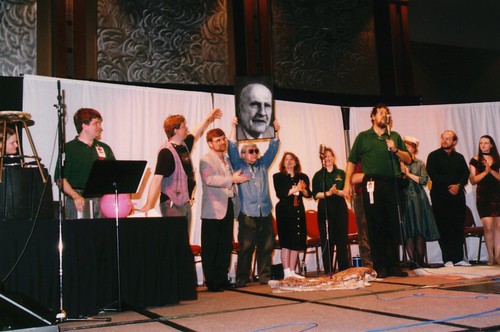
Anthony Daniels and Harlan Ellison share a stage with Daniel Taylor of ARTC.

So that happened, too. And then we’d cap the whole thing off by making it a tribute to the Dean of American Science Fiction himself.

A tribute to Robert A. Heinlein with Harlan Ellison, Brad Linaweaver, and William Alan Ritch.

The presence of scream queen Brinke Stevens in our opening piece, A Real Babe (by Brad Linaweaver, adapted for audio by William Alan Ritch) was just the icing on the cake.

Scream queen Brinke Stevens in
Scream queen Brinke Stevens in “A Real Babe”.

It was a performance for the ages. It was something nobody on the stage will ever forget.

*The Man Who Traveled in Elephants is currently available for sale exclusively at our live performances. We are hopeful to bring it back to general release in the near future through all of our digital and mail order distributors.

Posted on

ARTC Studio delivery and construction

We promised it to you a while back and we apologize for the delay, but good things come to those who wait and so here it is – the long-awaited saga of the delivery and construction of the ARTC Studio recording booth! If you want to see all the pictures, check out our Flickr page!

To begin, we’d like to thank our longtime recording home Audio Craft for many years of stellar work. We’re not done with Audio Craft by a long shot, but the demand for our studio work had grown so great that we really needed a space of our very own.

Here we see the bare room that we’ll be constructing in. There was some brief concern that we’d measured incorrectly and that the booth wasn’t going to fit in here, but as it turned out all was well.

Notice the stained glass lamp in the corner that one of our multi-talented members made!

The first step was getting it off the truck.

ARTC Executive Producer David Benedict poses here with the pallets still on the truck. You can’t really see it here, but the pallets were eight feet long and the truck driver had thought we had a forklift. We’re not sure how they arrived at that conclusion, but at least they brought a truck with a lift gate!


David and ARTC Board member Tony Fuller help the truck driver with the load. Discerning viewers will note a problem with the length of the pallet vs the width and depth of the lift gate.

Getting this off the truck safely was a tough job, but the driver really stepped up and …


We did it! And then we had to do it again, because there were two of these pallets. And then we had to carry all the individual boxes upstairs.


And, as you can see, there were a LOT of boxes. Don’t worry, folks, all that cardboard got recycled and didn’t find its way to the landfill!


Construction: Day 1

Construction took multiple days for a variety of reasons, most of which involved user error. Here we see David Benedict, Daniel Kiernan, and Bob Brown positioning the floor panels.


With the floor down, the next step was to position the walls. Here, Clair Kiernan and Bob Brown assess the situation and determine next steps.


The first major snag of the day. This, ultimately, was what caused us to take multiple days for construction. The instructions said to mount the door frame first, but the screw was stripped when we took delivery. While someone went to get a tool to let us remove it and get a replacement, the rest of us decided to go ahead and put up the other walls. This was a huge mistake, because it turns out that the reason you’re supposed to mount the door frame first is because it has a metal bracket that forces it into the proper alignment. The other walls don’t, and therefore the entire structure was skewed when we put up the last pieces. It took us time to figure that out, and then more time to loosen all the screws, shift things where they should have been in the first place, and then tighten it all back down again.

Here you can see Tony Fuller and David Benedict putting what they thought were some of the finishing touches on the recording booth. Little did they know that there would be at least three more visits to the studio space before everything would be where it really belonged.


But eventually it all came together! You can see some of the ventilation on the right hand side. The microphones we bought for the studio are super-sensitive, but the ventilation silencing systems on these booths is actually extremely good and you can barely tell the difference!


And of course it’s still a work in progress. Here’s a preliminary setup, but we’ve got ideas for how to make ARTC Studio even better and we’re looking forward to ramping up production before this month is out!

We’ll be concentrating on finishing up some existing projects, but new recordings are coming, too, so stay tuned!

Posted on

The Inaudible Man – Ron N. Butler

We continue our celebration of our 30th anniversary with a piece that Ron N. Butler wrote back in 1992 for the Myriad Amateur Press Alliance about his experiences with The Invisible Man. A few notes before we get to Ron’s own notes:

  1. We no longer have such a sweet deal with Dragon Con as Ron describes in his piece. So if you want to come join, feel free, but don’t count on getting everyone you know into the convention for free.
  2. At one very memorable show, Daniel Taylor did indeed fire off the starter pistol Ron mentions later in the piece. If only he’d warned us…and our audio engineer.
  3. We performed a few pieces live on PSPR (now Georgia Public Broadcasting) (although The Invisible Man wasn’t one of them). We’d love to be invited back sometime. Hint hint.

And now…without further ado, Ron N. Butler’s notes about his own piece, The Inaudible Man:

————————————

In 1986, Confederation — The Atlanta WorldCon — did something strange and unforgiveable in the eyes of SMOFdom: They had money left over after paying all the bills. Over the next couple of years, the rump Atlanta WorldCon committee parceled out the money as grants to a number of projects, among them ‘Electrical Eggs,’ one of the first (if not the first) organizations devoted to handicapped access at SF conventions. One of the other proposals was for a science fiction magazine on audiotape, pitched by a group calling themselves the Atlanta Radio Theatre Company. We funded that one, too. That’s how I met Thomas E. Fuller, ARTC’s head writer. And he remembered my name when ARTC needed someone to fill a gap in their cast for an adaptation of H.G. Wells’s The Invisible Man at DragonCon in 1992.

“The Inaudible Man” appeared in a somewhat different form as part of my personalzine “F451” in the MYRIAD APA. I have added some parenthetical notes but mainly left it as-is, for good or ill. This is how I met Thomas Fuller and how I joined ARTC. And that made a great difference in my life.

RNB

————————————————————————————————————–
THE INAUDIBLE MAN

(July 5, 1992) It was Thomas Fuller on the other end of the line — playwright, poet, soon-to-be SF novelist, Atlanta Radio Theater mogul, giant dirigible enthusiast (That is, the dirigibles are giant, not — well, never mind.), and Berta’s husband.

“Ron!” he said, little realizing that I had just blown an entire paragraph on a smartass description of him. “ARTC is doing ‘The Invisible Man’ down at DragonCon this year — ”

Well, I thought, at least it’s not Lovecraft…

” — but Greg Nicoll has had to drop out because of work. Would you like to take over his part?”

Would I? Would I? Wells? Radio theater? Acting without having to memorize lines? I’d give at least an earlobe for this!

“Yeah, sure — if Lin [My wife. — RNB] says it’s OK.”

“Great. See you Wednesday at 7:30.” *click*

Errr — Where?

(July 8) At first, Berta had refused to tell me where the house was. But after I reminded her that if I didn’t show up, Thomas would just replace me — likely with someone even worse — she gave in. [This is pure, bumptious fantasy. Berta was perfectly gracious. — RNB]

I stayed at work an extra ninety minutes before heading north for Duluth. That was cutting it a bit too fine, as it turned out; I just had time to grab a sandwich and a Coke at Mrs. Winner’s in downtown Duluth (I think that was downtown Duluth) and race back to the Fullers’, arriving right at 7:30.

(I was dogged by a strange punctuality all through this production. No matter what I did, I seemed to show up where I was supposed to be right on time — not early, not late, just — there. Spooky.)

Berta and the boys were off riding hot-air balloons while Thomas and ARTC took over her dining room to rehearse. Half of the cast were already there.

Brad Strickland had brought along a huge boom box to record a rough tape of the read-through which would be passed on to the sound effects guy for his edification.

Daniel “Foley” Taylor was there to read off the sound effects cues.

I recognized Doug Kaye from a presentation he and Thomas had made for the Phoenix Society about another SF audio project — something to do with a time-travelling actor in a bunny suit… [“Dash Cardigan” — RNB]

Thomas introduced me to the female leads, Joyce and Lee [Millman] — and I promptly got them mixed up. (Maybe that had something to do with the way that Joyce’s full name is Joyce Leigh.)

A tall, happy-looking fella named Bill Jackson seemed oddly familiar.

The redoubtable Berl Boykin (whom I remembered from a previous ARTC/DragonCon production of “Shadow over Innsmouth”) would not be at that rehearsal — his car had burned down. (Or some such damn thing. The week previously his bedroom ceiling had fallen in on him.) Thomas would read Griffin, the Invisible Man.

Before we got started, Thomas and I had a penetrating and lengthy discussion of motivation and characterization:

“Can you do an English accent?”

“Well — ”

“Greg’s been playing ‘Fearenside’ as an older man with a deep, gruff voice.”

I looked at the script. Oh, what the hell — when in doubt, do “Blind Pew”. “Oi’ve been loadin’ and unloadin’ derries fur thirty yee-ars and — ”

“Great! Next!”

About forty-five minutes after our nominal starting time (i.e. about fifteen minutes earlier than a Mighty Rassilon Art Players rehearsal would have started), we gathered around Thomas’ dining room table, shoved the chips and dip and soft drinks into the center, and began reading. The rest of the cast had done this four or five times before, while I had had the script in my hands for under an hour. Mercifully, Thomas decided on a “cold” read-through for me before Brad Strickland’s boombox started recording.

It was a good script. (Thomas said later that this script was his first audio adaptation of Wells. He has a “Time Machine” script, but that began life as a stage play, produced in Hawaii.) It was surprising how many of the words were Wells’ own, considering that the audio production would run only about 35 minutes. For some reason, I had remembered Wells’ novel as being a short thing, almost a novella. When I dragged out my “Seven Science Fiction Novels of H.G. Wells” a few days before the rehearsal, I realized where I got that impression: It should have been a novella. In modern hands, that’s what it would have been. Under John W. Campbell’s blue pencil, it would have been a novelette. But Wells had written a leisurely Victorian novel, stuffed with late-19th-century social detail. Any audio script that isn’t to run four hours does well to catch the essentials of the story.

The first run-through went well. I stepped on a few lines, missed a few sound cues. For the second run-through, Brad Strickland set his boombox a-recording — and we got about 25 pages into the 34-page script before anyone noticed that the tape in the cassette wasn’t turning. Oh, my —

Another ten-minute break. I called Lin to let her know I’d be very late, and we went back to it. For being made on a boombox with a tiny condenser microphone, the resulting tape sounded surprisingly good — except me. I’d recognize that nasal, dweeby voice anywhere. Grg! Why did I get into this? Just to seize another chance to make an idiot of myself in front of friends and family?

Home around 11:30. Up at 5:15. *Urg!*

(July 31) There were two more rehearsals — one on Sunday and the last on the following Wednesday, the 15th. (I finally broke down at the last ‘un and asked Daniel Taylor where I knew Bill Jackson from. He confirmed my suspicions: the mundane Bill Jackson is “Sir William Colquitt” in the SCA, [Society for Creative Anachronism] one of the few SCA muckety-mucks I have never heard an ill word spoken of. Bill looked familiar because that was my sole acquaintance with him: seeing him. Generally from a distance of not less than ten feet.)

The last rehearsal was also videotaped. Berl Boykin (who did make the last two rehearsals) had/ has plans for a “Making of ‘The Invisible Man’” documentary of some sort, and brought in a camera crew to tape us all sitting around Thomas’ table.

(Of the four-person crew, three were black. And here I was, in my “Blind Pew” voice, bellowing out the suspicions of “Fearenside”, the late nineteenth century English bumpkin, concerning the bandaged stranger: “He’s bla-a-ack! …He’s a piebald, black here, white there. …He’s some sort of arf-breed, an’ he’s ashimed of hit.”

(Thus do we progress: Now I don’t even need to get up in front of an audience to embarrass myself. I can embarrass myself in someone’s dining room.)

Berl did one thing, though, that made me feel very much more comfortable about my own performance: his accent. Where mine was bad, his was terrible. No offense and no disparagement of Berl’s talents meant, but that accent never got farther east than Nantucket. Thank you, Berl.

Every year, I intend to skip DragonCon. And every year, I seem to end up down there somehow. Last year, I was performing in a Mighty Rassilon Art Players’ production of “Two’s A Crowd” and we had to pay to get Lin in. At least Atlanta Radio Theater Company has a spiffy deal that gets its members’ spouses and significant others in free, too. It was $70 saved, especially as Lin and I would likely have gone to D’Con anyway — friends Ben and T Boyer were barnstorming through between Florida and Texas, alighting briefly in Atlanta, mostly down at the Hilton Towers. Getting into D’Con free is probably the biggest payoff I’ve gotten in my darkly checkered theatrical career.

Lin and I planned on making an evening of it. We hired Claudia, our daytime babysitter’s daughter, to look after the boys. Lin would get her set up over at the house about the time I was getting in a final rehearsal at the Hilton, then come on down, see the show, and we would party-hop or bar-sit afterwards with friends until the wild, ungodly hour of — oh, 10:30. Maybe even 11:00!

Enough persiflage. I gathered with the rest of the ARTC folks outside the ballroom at the Hilton at 6:00 on Saturday night for our setup and run-through, and waited. And waited. And waited…

There was to be a band, “Those Damned Johnstons” I believe, playing in the ballroom later that night and DragonCon had decided to let them set up before ARTC. Well, as bands will, they took forever for their sound checks and tweakery. Some of us tried hanging around inside, but TDJ being a modern band, the noise level soon drove us out again. I believe we got to take the stage about ten minutes before our scheduled start time. So much for mike checks and rehearsal. Oh, well… It’s not as if I needed any familiarization with mikes and procedures or such before my first audio production in my entire life. No. Not at all. I’ll be fine. (*grmf*)

There was considerable discussion between the sound effects man, Thomas, and Daniel “Foley” Taylor about six gunshots that have to be fired in mid-play (plus one more later). Daniel had come up with a seven-shot starter’s pistol — only to be told that if he fired it in the Hilton’s ballroom, Hotel Security would come charging in and shoot him dead. Sound effects had gunshots on CD — but the “cycle time” would be very slow. The method finally settled on was popping balloons inside empty oil drums. It sounded — adequate. (If you think this is bizarre, ask Daniel or Thomas how the sound of the hatch of a Martian space-cylinder was done for Orson Welles’ classic “War of the Worlds.”)

A few minutes after 8:00, we all lined up before the row of mikes on the stage, with the foley and sound- effects tables behind us or to the side. We’d never gotten a chance to do a proper sound check. Thomas and I ended up using the same mike — a bit awkward as Thomas is, of course, six feet nineteen-and-a-half inches tall while I shop for clothes in the “Stylish Dwarf” section of Penney’s.

Thirty-five minutes later, we were done — just like at rehearsal. I thanked everyone in line-of-sight for letting me play with them, then hopped down to look for wife and friends.

“How did it sound?” I asked Lin, and she answered, “Oh, it was just fine-” — in that way that your spouse can say things that make you instantly think of open flies and bits of spinach stuck between your front teeth.

“OK — give.”

Well, basically, while Thomas and I were not — exactly — sharing a dead mike, we were sharing a weak one. Now, Thomas would be audible reading clean limericks on a windy football field during band practice, but I was doing mime. Lin said I could be heard — if you were listening closely. Fortunately, Fearenside’s lines don’t seem to have been exactly crucial to the audiences’ following the continuity of the play. Still, it was a bit of a letdown. Thomas was the Invisible Man —

And I was the Inaudible Man.

One of the really nice things about audio, though, is that there are occasional opportunities for redemption in the editing booth. I got one on “Invisible Man.” The week after DragonCon, the cast and crew got together in the studios of Georgia Public TV to do the really, truly, finally last dangerous version of “IM” — the one that would be broadcast over Peach State Public Radio. (PSPR’s offices are in the basement of GPTV’s building, something I had never had an inkling of. Some wit has pulled one stick-on “L” off the sign on their door, reducing them to “Georgia Pubic Radio”. God knows, it would probably do wonders for their audience share if that were an accurate description.) And budgetary realities being what they are this year GPTV’s TV studios are seeing very little video production, leaving them wide open for underfunded audio/radio groups to use their equipment.

PSPR had sent an observer to the DragonCon production and must have been not entirely appalled by what he saw, as they were making noises about using “IM” and some other Atlanta Radio Theater Company material on their network of ten stations around the state. Of course, their “budgetary realities” may have something to do with that, too. As I recall the numbers, PSPR gets about $500,000 a year — $300,000 of which goes straight to National Public Radio. That leaves $20,000 to run each radio station in their network; not enough to pay for a fulltime janitor for each transmitter unless he provides his own cleaning supplies. PSPR’s interest in high-quality, low-cost, available programming thus becomes as intuitively obvious as those math lemmae in high school were supposed to be.

This recording session for “Invisible Man” was as relaxed as the DragonCon performance was tense (for me, anyway). The GPTV studio was quite bare — a high, gray room with lights and supporting trusswork hovering near the ceiling and a curving back wall that made it seem larger than it really was. Sound effects and foley equipment were again arranged on two tables on the sides of the studio, with a semicircle of microphones on stands at the far end from the glass-fronted control booth.

[Small historical note: This was the very studio from which ARTC did its one and only thirteen-week season of live radio drama broadcasts for the Atlanta market.]

All the mikes worked, this time. The point was also made that these were marvelously directional, so I found myself sighting down the length of the thing whenever I had lines to speak, like staring down the barrel of a shotgun. I was determined to be heard, this time…

The company went through a few warming-up exercises, like practicing getting rid of pages of script without making noises that would show up on the tape. Producer William Brown came on the PA and pronounced mine particularly crisp and clear. (*Flush*)

The first run-through was a “crossed fingers” exercise — you always hope the first take will be perfect, but it seldom is. We got about two-thirds of the way through before everyone’s flubs began coming in. The starter pistol we’d been unable to use at DragonCon turned out to have a small problem with getting off more than three rounds in a row. (So maybe the balloons weren’t so bad after all.) And I had to struggle not to laugh at the spectacle of Thomas and Bill Jackson simulating an entire pub full of people off-mike, just the two of ’em, with much arm-waving and back-slapping.

After wrapping up the first attempt, everyone wandered down to the basement and the GPTV snack area. (Why does food seem to figure so sharply in my memories of radio?) Mr. Brown announced that he’d had to turn my mike input down, which didn’t bother me a bit. After twenty minutes or so, we wandered back to the studio and did it again — one and a half times more, then called it a night. The production crew played back some of the tape over the PA while Daniel packed away his foley equipment. I liked the timber of my “Fearenside” voice better in the first run-through, but what the heck. The material we heard was missing a number of effects and music (chimes), but it was still hard for me to believe this little group of people using relatively modest equipment had produced such a nice-sounding product.

The night was warm and humid when we walked out into the parking lot about 10:00, and a heavy rain descended on us between my leaving the front door and getting to my car.

( September 9: Current plans are for Peach State Public Radio to play “The Invisible Man” on Halloween. Alas, it will not be played on any Atlanta public radio outlet.

(Other ARTC projects in one state or another of preparation include an adaptation of “The Time Machine,” Lovecraft’s “At the Mountains of Madness,” and possibly one or more of Kipling’s SF stories.)

Taking the babysitter home after DragonCon, I tried to answer her question about what we’d been doing that evening. Depressingly, I found that “We were doing a radio drama version of Wells’ ‘The Invisible Man’” would not cut it, as this really very bright twelve-year-old young lady lacked some key concepts. Like “radio drama”. Radio in the last decade of the twentieth century, after all, consists of 1) music, 2) news, or 3) telephone call-in shows. Maybe I’d have done better to describe it as “kind of like a book on tape”.

Ditto “The Invisible Man.” Claudia had never heard of it. Nor of H.G. Wells. *Sigh* Could be there’s something to be said for “Illustrated Classics” comic books after all.


Posted on

What ARTC means to me – Brian Phillips

It’s our 30th Anniversary! All this year, we’ll be periodically posting stuff about what ARTC means to our members. If any of you want to chime in, send us a note! We’d love to hear about what kind of influence we’ve had on the lives of our listeners!

To get things kicked off, here’s a bit from one of our actors and writers, Brian Phillips:

——————————

I was the creative director for the Philco Radio Players, a troupe that I had joined when I answered a newspaper ad for voice talent.  This began a long and happy association with that group as well as a fellow named Robert Drake.  Robert, in turn, asked me to come along with him to dinner, which is where I met David Benedict.  David let me know about the weekly ARTC practice sessions.

At this time, Philco was dormant and I was anxious to do more radio theater.  ARTC provided with me with the outlet to do this,as well as write scripts, one of which, “Night Call”, was performed at DragonCon.  There is nothing like listening to a large audience laughing at what you wrote.
Working with ARTC is wonderful.  Not only are the people talented, but we share many of the same literary experiences, so rehearsal is much like doing a party piece for relatives.
Over the years, I’ve been able to play various roles, which I enjoy, because in radio, it’s what you sound like, not what you look like.  Some of the roles I’ve played a reporter, a bratty kid, an alien who sounds like he’s from the UK, a military man, an egotistical scientist, a henpecked Southern husband, all through the writing of Kelly Ceccato, H. Beam Piper, Ron Butler and Theodore Sturgeon, to name a few.  It’s been a great deal of fun and I hope to do more!
Thank you, ARTC!
 – Brian Phillips